| Capital | Washington D.C. |
|---|---|
| Population | 340 110 988 inh. |
| Area | 9 831 510 km² |
| Population density | 34.6 inh./km² |
| Local time | --:-- (multiple time zones) |
| Language(s) | English |
| Political system | Federal presidential constitutional republic |
| National motto | In God We Trust and E pluribus unum |
| National anthem | The Star-Spangled Banner |
| Currency | United States dollar (USD) |
| History | View timeline |
| Land borders | Canada, Mexico |
| Maritime borders | Pacific Ocean, Atlantic Ocean |
The flag: history and symbolism
Flag History
The first official flag of the United States was set out by a resolution of the Continental Congress on 14 June 1777: thirteen alternating red and white stripes and thirteen white stars on a blue field, representing the thirteen founding colonies, with no exact arrangement of the stars specified.
In 1795, two extra stripes and two extra stars were added to mark the admission of Vermont and Kentucky to the Union: it was this fifteen-stripe flag that flew over Fort McHenry in 1814 and inspired the national anthem, "The Star-Spangled Banner." The Flag Act of 1818 then permanently fixed the number of stripes at thirteen, in honor of the original colonies, and provided for a new star to be added for each new state admitted to the Union.
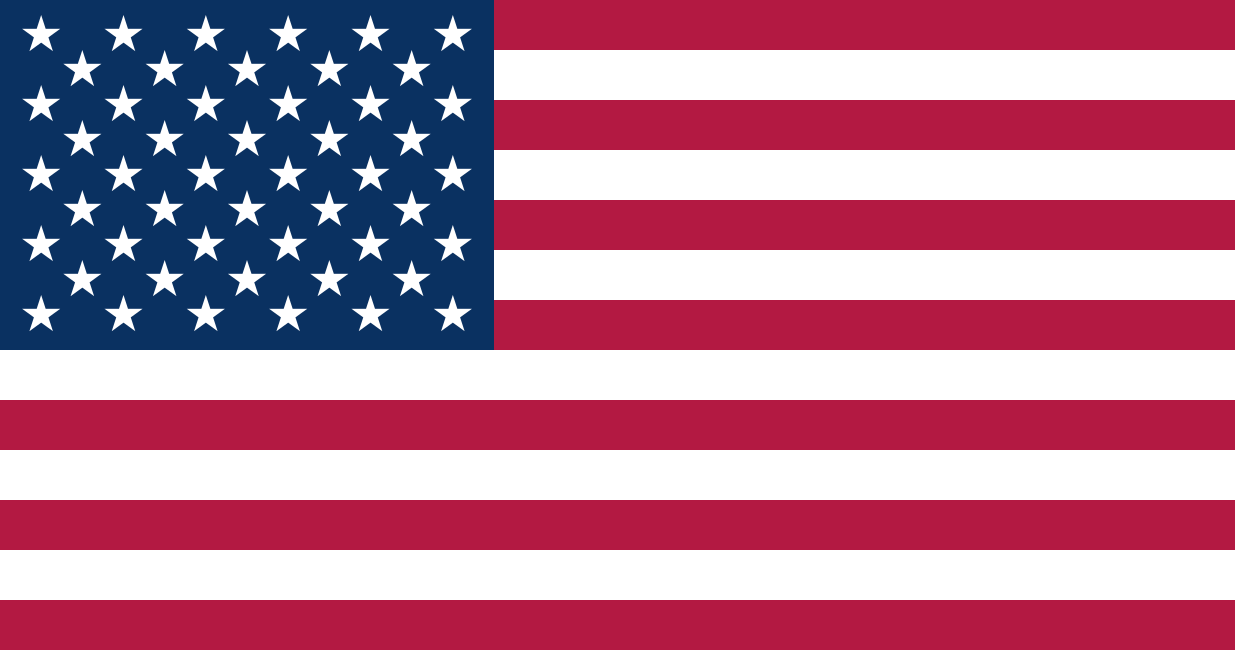
The current fifty-star flag dates from 4 July 1960, following the admission of Alaska in 1959 and then Hawaii, bringing the number of states to fifty.
Meaning of Colors & Emblems
An official meaning for the colors does in fact exist, unlike most national flags: in 1782, the Continental Congress assigned it to the Great Seal of the United States, a symbolism later carried over to the flag itself.
- Red: valor and hardiness.
- White: purity and innocence.
- Blue: vigilance, perseverance and justice.
The thirteen stripes represent the thirteen founding colonies, while each of the fifty stars today represents one of the fifty states of the Union.
Anecdotes & Fun Facts
According to a widely told story never confirmed by historians for lack of contemporary documents, Philadelphia seamstress Betsy Ross is said to have sewn the very first American flag in 1776 at George Washington's request. The story only appears in print from 1870 onward, recounted by her grandson nearly a century after the fact.
Today's fifty-star flag began life as a school project: in 1958, Ohio high school student Robert Heft designed a fifty-star pattern in anticipation of Alaska's and Hawaii's expected admission to the Union. His teacher initially gave the project a middling grade, only raising it after President Eisenhower selected the design, among those submitted, for the new official flag of 1960.
The 1795 flag, with fifteen stripes and fifteen stars, remains to this day the only American flag ever to have had more than thirteen stripes.
Sport and history
Athletes
- Ashton Eaton
- Christian Taylor
- Ryan Crouser
- Valarie Allman
- Michael Jordan
- Greg LeMond
- Kristin Armstrong
- Lance Armstrong
- Alberto Salazar
- Bill Rodgers
- Deena Kastor
- Greg Meyer
- Joan Benoit
- Khalid Khannouchi
- Kim Merritt
- Meb Keflezighi
- Miki Gorman
- Nina Kuscsik
- Eddie Lawson
- Kenny Roberts
- Wayne Rainey
- Hurley Haywood
- Phil Hill
- Claressa Shields
- Jennifer Valente
- Kayla Harrison
- Kim Rhode
- Lee Kiefer
- Mariel Zagunis
- Simone Biles
- Vincent Hancock
- Aaron Peirsol
- Bobby Finke
- Caeleb Dressel
- Katie Ledecky
- Michael Phelps
- Missy Franklin
- Natalie Coughlin
- Rebecca Soni
- Ryan Lochte
- Ryan Murphy
- Serena Williams
- Courtney Dauwalter
- Jim Walmsley
- Katie Schide
- Dave Scott
- Mark Allen
Competitions
Olympic Games
History
Historical figures
Frequently asked questions
What is the capital of the United States?
Washington D.C. is the capital of the United States.
What do the colors of the flag of the United States mean?
An official meaning for the colors does in fact exist, unlike most national flags: in 1782, the Continental Congress assigned it to the Great Seal of the United States, a symbolism later carried over to the flag itself.Red: valor and hardiness.White: purity and innocence.Blue: vigilance, perseverance and justice.The thirteen stripes represent the thirteen founding colonies, while each of the fifty stars today represents one of the fifty states of the Union.