| Capital | Tokyo |
|---|---|
| Population | 123 975 371 inh. |
| Area | 377 969 km² |
| Population density | 328.0 inh./km² |
| Local time | --:-- |
| Language(s) | None |
| Political system | Unitary parliamentary constitutional monarchy |
| National anthem | Kimi ga yo (His Imperial Majesty's Reign) |
| Currency | Japanese yen (JPY) |
| History | View timeline |
| Maritime borders | Sea of Japan, Pacific Ocean |
The flag: history and symbolism
Flag History
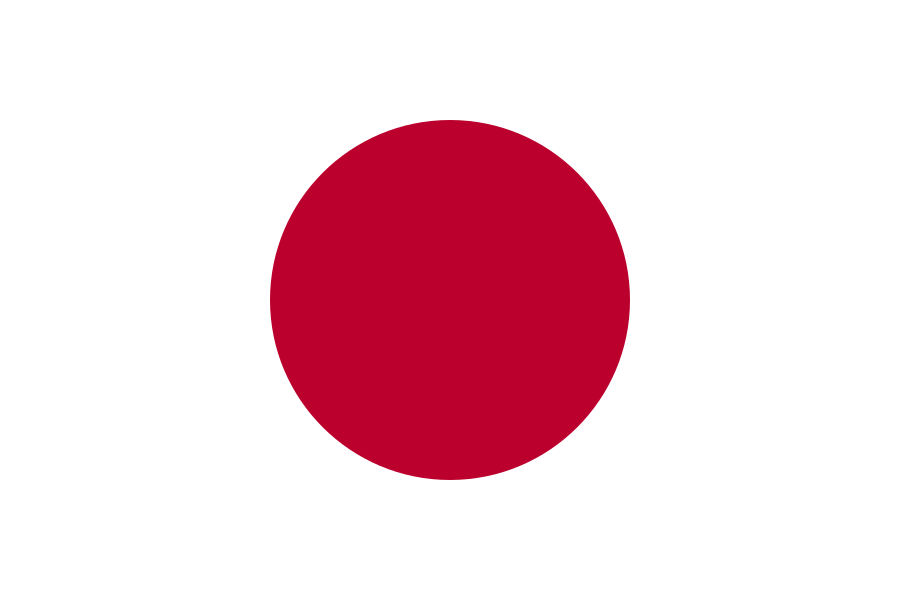
The red sun disc on a white field, known as the Hinomaru, draws on symbols far older than the modern Japanese state. Japan calls itself the "Land of the Rising Sun," and banners bearing a red sun are recorded as early as the medieval period, notably carried by warrior clans.
On 27 February 1870 (the third year of the Meiji era), an ordinance made the Hinomaru compulsory on Japanese merchant ships, making it the country's de facto national flag. A reform of legal codification in 1885, however, repealed this text without replacing it: for over a century, Japan used its flag simply by custom, with no official legal basis.
It was not until 13 August 1999 that the Act on National Flag and Anthem finally established the Hinomaru as the official national flag, fixing its proportions at 2:3 and the red disc, centered, at three-fifths of the flag's height.
Meaning of Colors & Emblems
White symbolizes purity, honesty and integrity; red represents sincerity, vitality and, of course, the sun itself, echoing the Japanese name for the archipelago, Nihon or Nippon, literally "origin of the sun."
Unlike flags built from several distinct symbols, the Hinomaru draws its strength from the simplicity of a single red disc, a minimalism that makes it one of the most recognizable national flags in the world.
Anecdotes & Fun Facts
During the American occupation of Japan, between 1945 and 1952, use of the Hinomaru was heavily restricted: civilians first needed permission from Allied command to display it, before the rules were gradually relaxed.
The Hinomaru remains a sensitive symbol within Japan itself: associated by some with the imperialism and militarism of the early twentieth century, its mandatory use at school ceremonies, reinforced after the 1999 law, has sparked protests, including resignations by teachers who refused to salute it.
Before the 1999 law, the red disc had never been precisely defined by an official text: its exact size and position varied slightly from one manufacturer to another for more than a century.
Sport and history
Athletes
Olympic Games
Frequently asked questions
What is the capital of Japan?
Tokyo is the capital of Japan.
What do the colors of the flag of Japan mean?
White symbolizes purity, honesty and integrity; red represents sincerity, vitality and, of course, the sun itself, echoing the Japanese name for the archipelago, Nihon or Nippon, literally "origin of the sun."Unlike flags built from several distinct symbols, the Hinomaru draws its strength from the simplicity of a single red disc, a minimalism that makes it one of the most recognizable national flags in the world.