| Capital | Brasilia |
|---|---|
| Population | 211 998 573 inh. |
| Area | 8 510 420 km² |
| Population density | 24.9 inh./km² |
| Local time | --:-- (multiple time zones) |
| Language(s) | Portuguese |
| Political system | Federal presidential constitutional republic |
| National motto | Ordem e Progresso (Order and Progress) |
| National anthem | Hino Nacional Brasileiro (Brazilian National Anthem) |
| Currency | Brazilian real (BRL) |
| History | View timeline |
| Land borders | Guyane française, Suriname, Guyana, Venezuela, Colombia, Peru, Bolivia, Paraguay, Argentina, Uruguay |
| Maritime borders | Atlantic Ocean |
The flag: history and symbolism
Flag History
The current flag was adopted on 19 November 1889, just four days after the Republic was proclaimed on 15 November 1889, ending the Empire of Brazil. A first republican flag, inspired by that of the United States, was briefly raised before being abandoned.
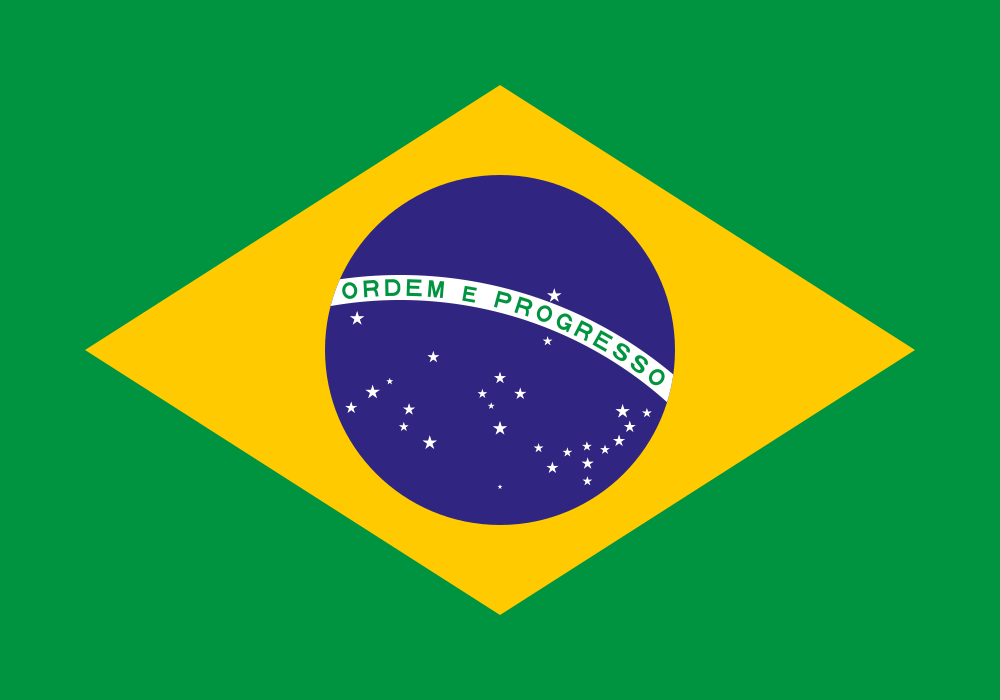
The new design kept the golden rhombus on a green field inherited from the imperial flag but replaced the imperial coat of arms with a blue celestial globe bearing the Southern Cross and a constellation of white stars. These stars reproduce the exact position of the sky over Rio de Janeiro on the morning of 19 November 1889, calculated by the astronomer Manuel Pereira Reis.
The number of stars has changed along with the country's administrative divisions: 21 at first, it now stands at 27, one for each federated state plus one for the Federal District, the last one added in 1992 for the state of Tocantins.
Meaning of Colors & Emblems
Green and yellow come from the imperial flag: green stood for the House of Braganza of Emperor Pedro I, yellow for the House of Habsburg of his wife, Empress Maria Leopoldina. After the fall of the Empire, a more popular reading took hold, linking green to the country's forests and yellow to its mineral wealth.
- Blue globe and stars: the sky over Brazil on the morning the Republic was proclaimed, each star representing a federated state.
- Motto "Ordem e Progresso" (Order and Progress): drawn from the motto of the French positivist philosopher Auguste Comte, highly influential among Brazil's early republicans.
Anecdotes & Fun Facts
The arrangement of the stars is not decorative: it reproduces an actual map of the sky, calculated from the exact sidereal time on 19 November 1889, as though viewed from outside the celestial sphere rather than from the ground.
The motto "Ordem e Progresso" is a shortened version of Auguste Comte's maxim: "Love as a principle, order as a basis, progress as a goal." The flag keeps only the last two terms.
The number of stars has changed several times since 1889 as new states were created; the most recent change, in 1992, added the star for Tocantins, bringing the total to 27.
Sport and history
Athletes
Competitions
Olympic Games
Frequently asked questions
What is the capital of Brazil?
Brasilia is the capital of Brazil.
What do the colors of the flag of Brazil mean?
Green and yellow come from the imperial flag: green stood for the House of Braganza of Emperor Pedro I, yellow for the House of Habsburg of his wife, Empress Maria Leopoldina. After the fall of the Empire, a more popular reading took hold, linking green to the country's forests and yellow to its mineral wealth.Blue globe and stars: the sky over Brazil on the morning the Republic was proclaimed, each star representing a federated state.Motto "Ordem e Progresso" (Order and Progress): drawn from the motto of the French positivist philosopher Auguste Comte, highly influential among Brazil's early republicans.