| Capital | Berlin |
|---|---|
| Population | 83 510 950 inh. |
| Area | 357 600 km² |
| Population density | 233.5 inh./km² |
| Local time | --:-- |
| Language(s) | German |
| Political system | Federal parliamentary republic |
| National motto | Einigkeit und Recht und Freiheit (Unity and Justice and Freedom) |
| National anthem | Deutschlandlied (Song of Germany) |
| Currency | Euro (EUR) |
| History | View timeline |
| Land borders | Denmark, Poland, Czech Republic, Austria, Switzerland, France, Luxembourg, Belgium, Netherlands |
| Maritime borders | North Sea, Baltic Sea |
The flag: history and symbolism
Flag History
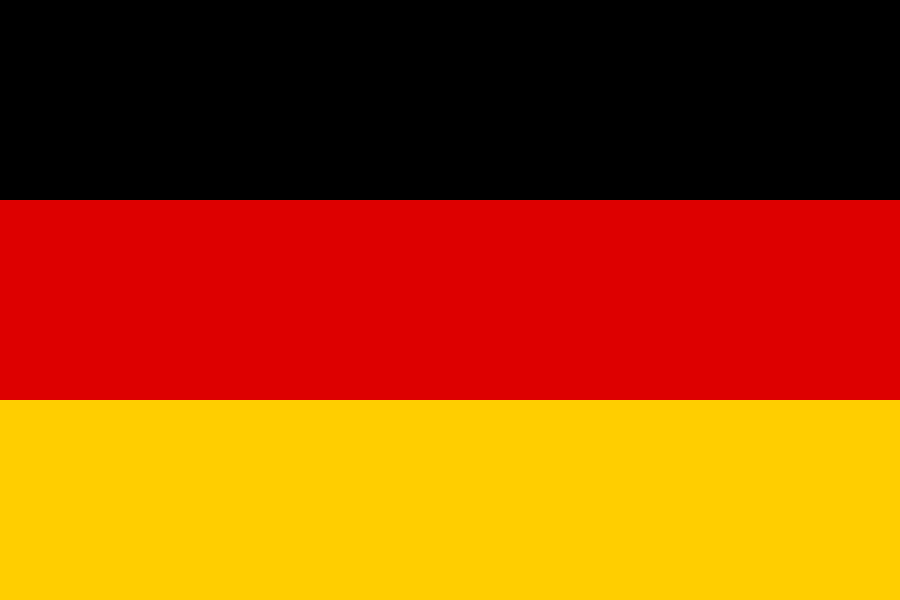
The black, red and gold colors originate in the uniforms of the Lützow Free Corps, a volunteer unit formed in 1813 to fight Napoleon's forces. Made up of men from across the German lands who arrived wearing mismatched clothing, the unit dyed everything black for uniformity, adding red facings and gold-colored buttons.
These colors were taken up as early as 1815 by nationalist student fraternities, then popularized at major gatherings such as the Wartburg Festival of 1817 and the Hambach Festival of 1832, before being adopted as the official flag of the German Confederation's diet on 9 March 1848.
The German Empire of 1871 preferred black, white and red, the colors of Prussia. Black, red and gold only became the national flag again with the Weimar Republic in 1919, disappeared under the Third Reich in favor of the Nazi flag, and was then restored by both German states in 1949 and kept unchanged after reunification in 1990.
Meaning of Colors & Emblems
No official text assigns a precise meaning to each of the three colors. A popular interpretation, dating from the nineteenth century and tied to the origins of the Lützow Free Corps, sums up their symbolism with the phrase "out of darkness (black), through blood (red), into light (gold)," a reference to the march toward German unity and freedom.
Another reading links the colors to the imperial eagle of the Holy Roman Empire: black on a gold field, with a red beak and claws, a symbol that early nineteenth-century nationalist students were deliberately trying to revive.
Anecdotes & Fun Facts
Black-red-gold and black-white-red long competed for the status of Germany's national colors: the latter, inherited from Prussia, dressed the Empire from 1871 to 1918 and briefly resurfaced under the Weimar Republic as a commercial flag alongside black-red-gold, which remained the official one, a rivalry that fueled sharp political tension in the 1920s.
From 1959 to 1990, East Germany used the same black-red-gold flag as West Germany but added a national emblem at its center, a hammer and compass encircled by a wreath of wheat. That detail alone was enough to tell the two flags apart, so much so that some protesters cut the East German emblem out of their own flags during the demonstrations around the fall of the Berlin Wall in 1989.
Black, red and gold has only been the flag of a unified Germany twice in history before 1990: briefly between 1848 and 1852, then from 1919 to 1933.
Sport and history
Athletes
Clubs
Competitions
Historical figures
Frequently asked questions
What is the capital of Germany?
Berlin is the capital of Germany.
What do the colors of the flag of Germany mean?
No official text assigns a precise meaning to each of the three colors. A popular interpretation, dating from the nineteenth century and tied to the origins of the Lützow Free Corps, sums up their symbolism with the phrase "out of darkness (black), through blood (red), into light (gold)," a reference to the march toward German unity and freedom.Another reading links the colors to the imperial eagle of the Holy Roman Empire: black on a gold field, with a red beak and claws, a symbol that early nineteenth-century nationalist students were deliberately trying to revive.
Which countries border Germany?
Germany shares land borders with: Denmark, Poland, Czech Republic, Austria, Switzerland, France, Luxembourg, Belgium, Netherlands.