| Capital | Bern |
|---|---|
| Population | 9 034 102 inh. |
| Area | 41 290 km² |
| Population density | 218.8 inh./km² |
| Local time | --:-- |
| Language(s) | German, French, Italian, Romansh |
| Political system | Federal semi-direct democracy |
| National motto | Unus pro omnibus, omnes pro uno (One for all, all for one) |
| National anthem | Swiss Psalm |
| Currency | Swiss franc (CHF) |
| Land borders | Italy, France, Germany, Austria, Liechtenstein |
The flag: history and symbolism
Flag History
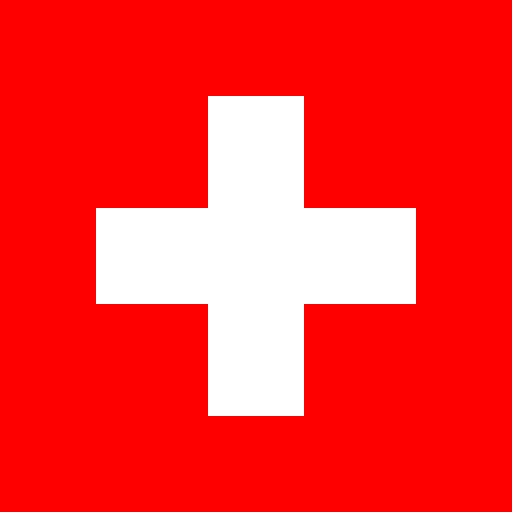
The white cross on a red field has its roots on medieval battlefields: as early as the Battle of Laupen in 1339, Confederate soldiers sewed a white cross onto their chainmail to tell themselves apart from opposing forces. The cross gradually became a shared rallying symbol among the different cantons.
The current design, a solid white cross on a red square, was fixed in 1840. It became the Confederation's official flag when the first federal constitution was adopted in 1848. The Federal Council set out its exact proportions on 12 November 1889: the arms of the cross must be one-sixth longer than they are wide.
Switzerland is today, along with Vatican City, one of only two countries in the world with a square rather than rectangular national flag.
Meaning of Colors & Emblems
The white cross draws on an old Christian tradition, used as a rallying sign by the Confederates from the fourteenth century onward. The red field is inherited from the banner colors of the Holy Roman Empire, which several Swiss cantons were subject to in the Middle Ages before the Confederation gradually gained independence.
More broadly, the white cross on red has come to symbolize neutrality, the unity of the cantons and Switzerland's independence.
Anecdotes & Fun Facts
The flag of the International Committee of the Red Cross, founded in Geneva in 1863 by the Swiss humanitarian Henry Dunant, reproduces the exact colors of the Swiss flag in reverse, a red cross on white, in tribute to the organization's country of origin.
Switzerland and Vatican City are the only two states in the world to use a square rather than a rectangular flag; for international use, such as aboard ships, a rectangular version of the Swiss flag is nonetheless tolerated.
The cross's exact proportions, fixed in 1889, with arms one-sixth longer than they are wide, officially distinguish the Swiss flag from a simple Greek cross with perfectly equal arms.
Sport and history
Athletes
Competitions
Olympic Games
Frequently asked questions
What is the capital of Switzerland?
Bern is the capital of Switzerland.
What do the colors of the flag of Switzerland mean?
The white cross draws on an old Christian tradition, used as a rallying sign by the Confederates from the fourteenth century onward. The red field is inherited from the banner colors of the Holy Roman Empire, which several Swiss cantons were subject to in the Middle Ages before the Confederation gradually gained independence.More broadly, the white cross on red has come to symbolize neutrality, the unity of the cantons and Switzerland's independence.
Which countries border Switzerland?
Switzerland shares land borders with: Italy, France, Germany, Austria, Liechtenstein.