| Capital | Rome |
|---|---|
| Population | 58 986 023 inh. |
| Area | 302 070 km² |
| Population density | 195.3 inh./km² |
| Local time | --:-- |
| Language(s) | Italian |
| Political system | Unitary parliamentary republic |
| National anthem | Il Canto degli Italiani (Fratelli d'Italia) |
| Currency | Euro (EUR) |
| History | View timeline |
| Land borders | France, Switzerland, Austria, Slovenia, Vatican City, San Marino |
| Maritime borders | Adriatic Sea, Ionian Sea, Tyrrhenian Sea, Mediterranean Sea |
The flag: history and symbolism
Flag History
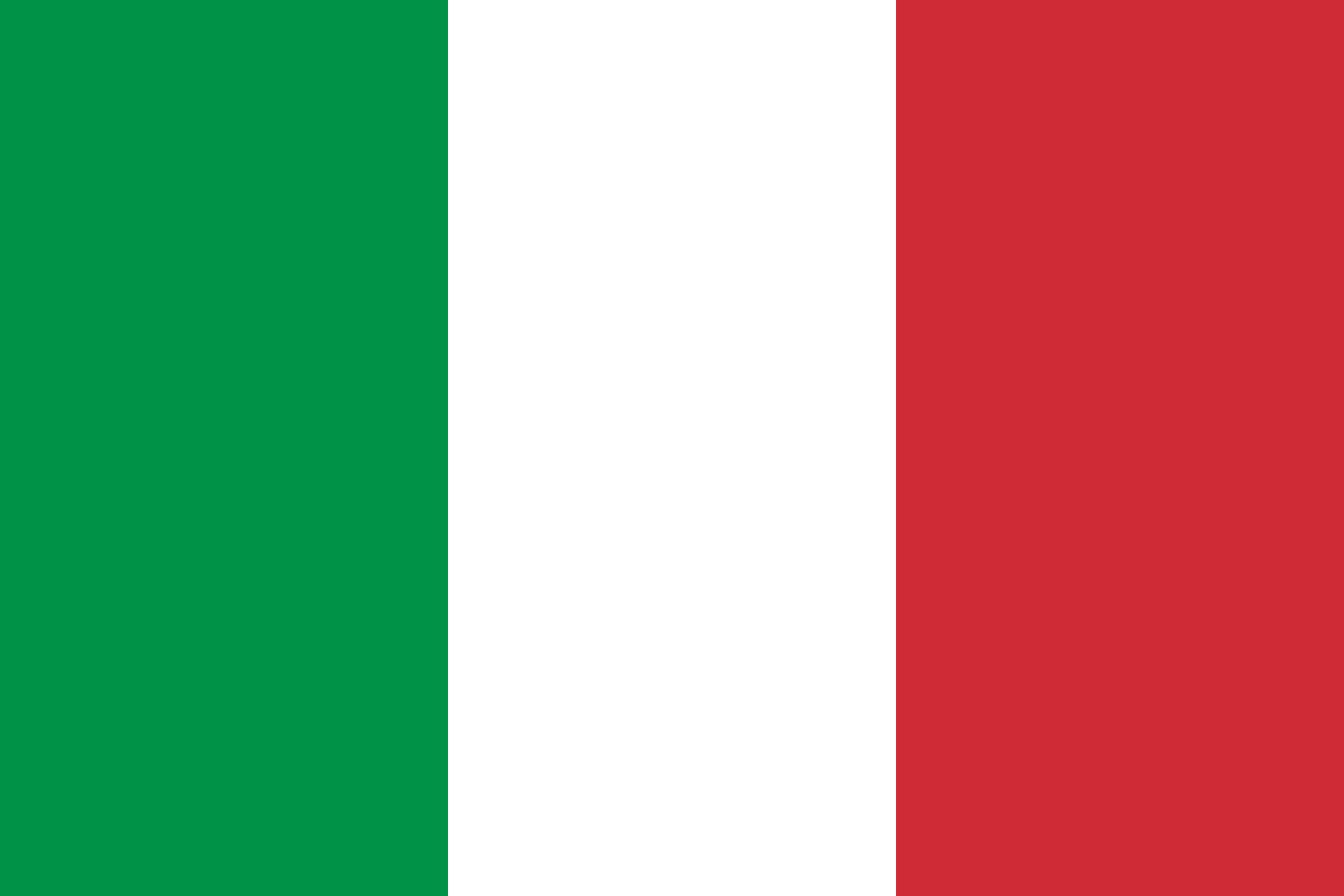
The Italian tricolor was born on 7 January 1797 in Reggio Emilia, where representatives of Reggio Emilia, Modena, Bologna and Ferrara proclaimed green, white and red the emblem of the Cispadane Republic, a short-lived state created under Napoleon Bonaparte's influence. The proposal was put forward by the deputy Giuseppe Compagnoni, since remembered as "the father of the tricolor."
The first Cispadane flag looked quite different from today's: its stripes ran horizontally, with red at the top, white in the middle and green at the bottom. It was the Cisalpine Republic, formed the same year from the merger of the Cispadane and Transpadane Republics, that adopted the vertical green-white-red arrangement later popularized.
The tricolor became the flag of the unified Kingdom of Italy in 1861, then bearing the arms of the House of Savoy at its center. After the fall of the monarchy in 1946, those arms were removed, and the plain green-white-red flag was confirmed as the Republic's emblem by Article 12 of the 1948 Constitution.
Meaning of Colors & Emblems
No Italian law has ever fixed an official meaning for the three colors. The most widespread interpretation, religious in origin and dating from the nineteenth century, nonetheless links each one to a theological virtue:
- Green: hope, also evoked by the country's plains and hills.
- White: faith, associated with the snow of the Alps.
- Red: charity, or the blood shed in the struggles for Italian unity.
A more down-to-earth theory links the choice of green to the uniform color of the Milanese civic guard of the time, combined with the white and red of the old Milanese cockade.
Anecdotes & Fun Facts
The very first tricolor of 1797 was neither arranged nor quite used the same way as today's: horizontal stripes, red on top, white in the middle, green at the bottom, with a quiver and four arrows at the center symbolizing the union of four cities. The vertical arrangement we know today only appeared with the Cisalpine Republic, later that same year.
Reggio Emilia, the birthplace of the tricolor, celebrates the Festa del Tricolore every 7 January, commemorating the 1797 proclamation; a flag museum is also housed in the town hall.
Between 1861 and 1946, the tricolor carried the arms of the House of Savoy at its center, tying it directly to the monarchy. Their removal after the 1946 institutional referendum symbolically marked the transition from kingdom to republic.
Sport and history
Athletes
Clubs
Competitions
Olympic Games
Historical figures
Frequently asked questions
What is the capital of Italy?
Rome is the capital of Italy.
What do the colors of the flag of Italy mean?
No Italian law has ever fixed an official meaning for the three colors. The most widespread interpretation, religious in origin and dating from the nineteenth century, nonetheless links each one to a theological virtue:Green: hope, also evoked by the country's plains and hills.White: faith, associated with the snow of the Alps.Red: charity, or the blood shed in the struggles for Italian unity.A more down-to-earth theory links the choice of green to the uniform color of the Milanese civic guard of the time, combined with the white and red of the old Milanese cockade.
Which countries border Italy?
Italy shares land borders with: France, Switzerland, Austria, Slovenia, Vatican City, San Marino.