| Capital | Beijing |
|---|---|
| Population | 1 408 975 000 inh. |
| Area | 9 562 910 km² |
| Population density | 147.3 inh./km² |
| Local time | --:-- |
| Language(s) | Standard Chinese |
| Political system | Unitary one-party socialist republic |
| National anthem | March of the Volunteers |
| Currency | Chinese yuan (CNY) |
| History | View timeline |
| Land borders | Vietnam, Laos, Myanmar, India, Bhutan, Nepal, Pakistan, Afghanistan, Tajikistan, Kyrgyzstan, Kazakhstan, Russia, Mongolia, Korea, North |
| Maritime borders | South China Sea, Yellow Sea, East China Sea |
The flag: history and symbolism
Flag History
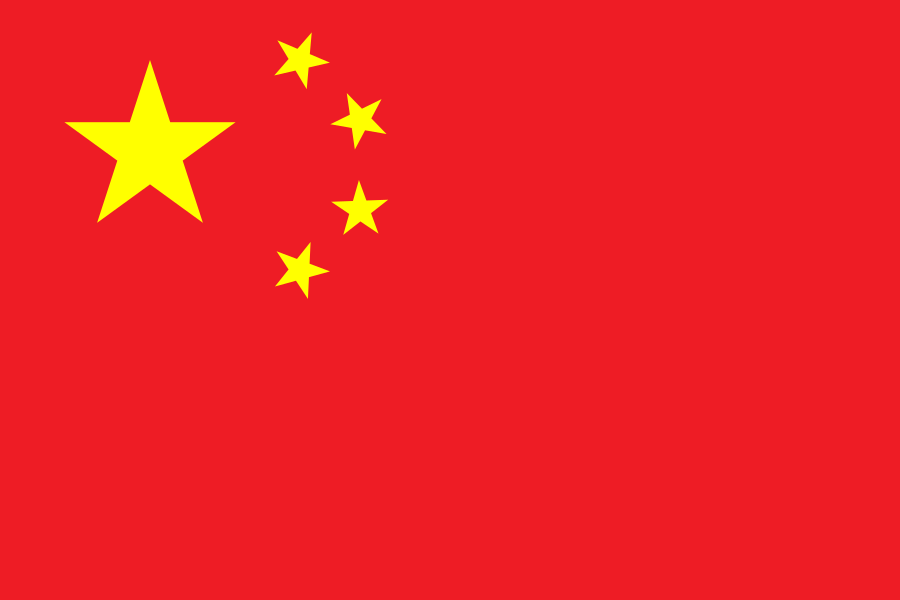
The current flag, known as the "Five-Star Red Flag," was adopted on 27 September 1949, just days before the People's Republic of China was proclaimed on 1 October 1949. It was chosen after a nationwide competition that drew more than three thousand submissions.
The winning design came from Zeng Liansong, a Shanghai economist with no formal design training. His initial version placed a hammer and sickle at the center of the large star, but that detail was dropped before final adoption: the selection committee feared it would make the flag too similar to that of the Soviet Union.
The final choice won out over Mao Zedong's own preferred design, which initially favored a simpler layout, a single star paired with a broad horizontal yellow band.
Meaning of Colors & Emblems
Red, a traditional festive color in China, also symbolizes the communist revolution. The large golden star represents the Communist Party of China, while the four smaller stars, arranged in an arc, represent the four social classes united under its leadership according to Mao's theory of "New Democracy": the working class, the peasantry, the urban petty bourgeoisie and the national bourgeoisie.
Each small star has one point aimed at the center of the large star, as though orbiting it, a graphic way of representing the union of these classes around the Party.
Anecdotes & Fun Facts
Zeng Liansong's original design featured a hammer and sickle at the center of the large star, symbols borrowed directly from the Soviet Union. This detail was dropped during the final selection specifically to avoid too close a resemblance to the Soviet flag.
Mao Zedong himself did not initially back Zeng Liansong's design: he preferred a simpler layout, with a single yellow star and a broad horizontal band, before eventually endorsing the committee's chosen proposal.
The four small stars do not represent the country's provinces or regions, contrary to an interpretation sometimes found abroad, but social categories as theorized by Mao Zedong at the time the regime was founded.
Sport and history
Athletes
- Cao Yuan
- Chen Meng
- Chen Ruolin
- Chen Yanqing
- Du Li
- Guo Jingjing
- Guo Wenjun
- Hou Zhihui
- Li Fabin
- Li Wenwen
- Lin Dan
- Liu Yang
- Long Qingquan
- Lü Xiaojun
- Ma Long
- Quan Hongchan
- Shi Tingmao
- Shi Zhiyong
- Wu Jingyu
- Xian Dongmei
- Xie Siyi
- Zhang Ning
- Zhang Yining
- Zou Jingyuan
- Zou Kai
- Zou Shiming
- Sun Yang
- Ye Shiwen
- Miao Yao
Olympic Games
History
Frequently asked questions
What is the capital of China?
Beijing is the capital of China.
What do the colors of the flag of China mean?
Red, a traditional festive color in China, also symbolizes the communist revolution. The large golden star represents the Communist Party of China, while the four smaller stars, arranged in an arc, represent the four social classes united under its leadership according to Mao's theory of "New Democracy": the working class, the peasantry, the urban petty bourgeoisie and the national bourgeoisie.Each small star has one point aimed at the center of the large star, as though orbiting it, a graphic way of representing the union of these classes around the Party.
Which countries border China?
China shares land borders with: Vietnam, Laos, Myanmar, India, Bhutan, Nepal, Pakistan, Afghanistan, Tajikistan, Kyrgyzstan, Kazakhstan, Russia, Mongolia, Korea, North.