| Capital | New Delhi |
|---|---|
| Population | 1 450 935 791 inh. |
| Area | 3 287 260 km² |
| Population density | 441.4 inh./km² |
| Local time | --:-- |
| Language(s) | English, Hindi |
| Political system | Federal parliamentary constitutional republic |
| National motto | Truth Alone Triumphs |
| National anthem | Jana Gana Mana |
| Currency | Indian rupee (INR) |
| History | View timeline |
| Land borders | Pakistan, China, Nepal, Bhutan, Bangladesh, Myanmar |
| Maritime borders | Indian Ocean, Andaman Sea |
The flag: history and symbolism
Flag History
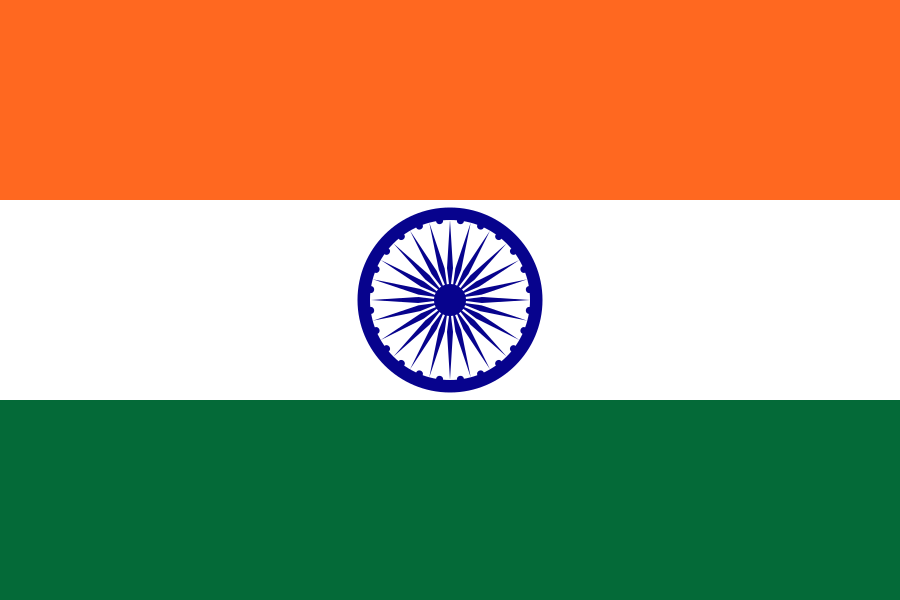
India's current flag was adopted by the Constituent Assembly on 22 July 1947, weeks before independence was proclaimed on 15 August 1947. It descends directly from a flag designed in 1921 by Pingali Venkayya and presented to the Indian National Congress in Vijayawada.
Venkayya's first version paired red, for the Hindu community, with green, for the Muslim community, later joined, at Gandhi's suggestion, by a white stripe representing the country's other communities, along with a spinning wheel symbolizing the self-reliance Gandhi advocated.
For the final 1947 flag, red gave way to saffron, and the spinning wheel was replaced by the Ashoka Chakra, a 24-spoke wheel taken directly from the Lion Capital of Ashoka at Sarnath, in order to offer a more universal symbol than one tied to a single community or craft.
Meaning of Colors & Emblems
- Saffron (top band): courage and sacrifice.
- White (middle band): truth, peace and purity.
- Green (bottom band): faith, fertility and prosperity.
- Ashoka Chakra (24 spokes, center): the wheel of dharma, moral law and cosmic order; its 24 spokes are said to evoke progress that must never stop.
When the flag was presented to the Constituent Assembly, the philosopher Sarvepalli Radhakrishnan stressed that the colors were not meant to represent any particular religion, unlike the original 1921 intent.
Anecdotes & Fun Facts
For more than fifty years after independence, the Indian Flag Code barred private citizens from flying the national flag on their buildings outside a handful of designated holidays. It took a long legal battle by industrialist Naveen Jindal to win recognition of that right: a reform of the Flag Code came into force in 2002, confirmed by a Supreme Court ruling in 2004 that recognized flying the flag as an expression of the right to freedom of speech.
The Ashoka Chakra on the flag is not an original creation: it reproduces exactly the wheel carved on the Lion Capital of Ashoka, a stone pillar dating from the third century BCE that is also, today, India's national emblem.
The spinning wheel from the original 1921 flag, a symbol close to Gandhi's heart of economic independence from imported British cloth, very nearly stayed on the final flag; it was only replaced by the Ashoka Chakra at the very last stage of the 1947 discussions.
Sport and history
National teams
Olympic Games
History
Historical figures
Frequently asked questions
What is the capital of India?
New Delhi is the capital of India.
What do the colors of the flag of India mean?
Saffron (top band): courage and sacrifice.White (middle band): truth, peace and purity.Green (bottom band): faith, fertility and prosperity.Ashoka Chakra (24 spokes, center): the wheel of dharma, moral law and cosmic order; its 24 spokes are said to evoke progress that must never stop.When the flag was presented to the Constituent Assembly, the philosopher Sarvepalli Radhakrishnan stressed that the colors were not meant to represent any particular religion, unlike the original 1921 intent.