| Capital | Madrid |
|---|---|
| Population | 48 807 137 inh. |
| Area | 505 978 km² |
| Population density | 96.5 inh./km² |
| Local time | --:-- |
| Language(s) | Spanish |
| Political system | Unitary parliamentary constitutional monarchy |
| National motto | Plus Ultra (Further Beyond) |
| National anthem | Marcha Real (Royal March) |
| Currency | Euro (EUR) |
| History | View timeline |
| Land borders | France, Portugal, Andorra, Morocco |
| Maritime borders | Atlantic Ocean, Mediterranean Sea |
The flag: history and symbolism
Flag History
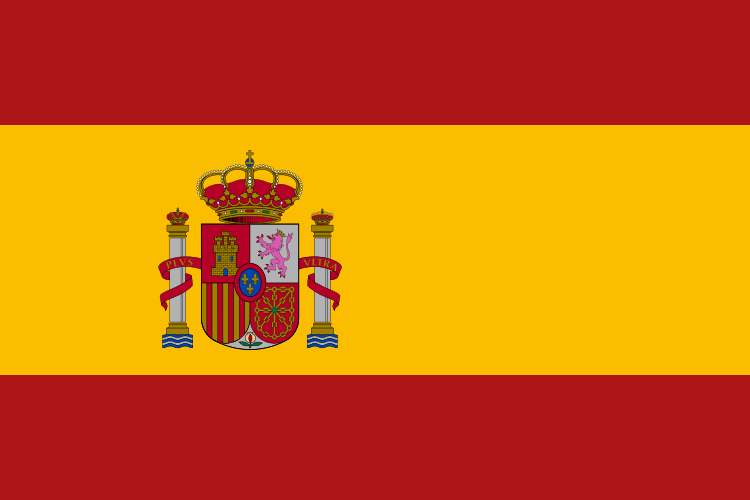
The current flag was born of a very practical problem at sea. In 1785, King Charles III noticed that Spain's white naval ensign, bearing the royal coat of arms, was easily confused at a distance with those of other powers that also used a white field, such as France or the Kingdom of Naples, making it hard to tell allied ships from enemy ones in the heat of battle.
The king commissioned his naval minister, Antonio Valdés y Bazán, to draw up a dozen designs that would be easier to distinguish from far away. Among the proposals, Charles III chose the one with three horizontal stripes, red, yellow and red, with the central yellow stripe twice as wide as the other two to maximize visual contrast at sea, including in fog or through the smoke of cannon fire.
Reserved at first for the navy, this design gradually became the national flag over the nineteenth and twentieth centuries, before being enshrined by the Spanish Constitution of 1978.
Meaning of Colors & Emblems
Contrary to a common belief, the choice of red and yellow rests on no official symbolism: it was, above all, a practical response to a need for visibility at sea, decided by Charles III in 1785. A popular historical reading nonetheless sees in it an echo of the colors of the old kingdoms of Castile and Aragon, from which modern Spain emerged.
The official version of the flag, used by the state, carries the national coat of arms at its center; a simpler version without the arms serves as the civil ensign for private use.
Anecdotes & Fun Facts
The red-yellow-red flag of 1785 is one of the oldest national flags still in use today, predating by several years the French tricolor born of the Revolution.
The central yellow stripe is not twice as wide by accident: this proportion, personally approved by Charles III among twelve designs submitted by his minister Antonio Valdés y Bazán, was chosen specifically to set Spanish ships apart from the largely white ensigns of France, Naples or Sicily.
During the Second Spanish Republic, between 1931 and 1939, the red-yellow-red flag was temporarily replaced by a red-yellow-purple tricolor, the third color historically associated with medieval Castile; the Franco regime later restored the traditional red-yellow-red flag.
Sport and history
Athletes
Clubs
Competitions
Olympic Games
History
Frequently asked questions
What is the capital of Spain?
Madrid is the capital of Spain.
What do the colors of the flag of Spain mean?
Contrary to a common belief, the choice of red and yellow rests on no official symbolism: it was, above all, a practical response to a need for visibility at sea, decided by Charles III in 1785. A popular historical reading nonetheless sees in it an echo of the colors of the old kingdoms of Castile and Aragon, from which modern Spain emerged.The official version of the flag, used by the state, carries the national coat of arms at its center; a simpler version without the arms serves as the civil ensign for private use.