| Capital | London |
|---|---|
| Population | 69 226 000 inh. |
| Area | 243 610 km² |
| Population density | 284.2 inh./km² |
| Local time | --:-- |
| Language(s) | English |
| Political system | Unitary parliamentary constitutional monarchy |
| National motto | Dieu et mon droit |
| National anthem | God save the Queen |
| Currency | British pound (GBP) |
| History | View timeline |
| Land borders | Ireland |
| Maritime borders | Atlantic Ocean, North Sea, English Channel, Irish Sea |
The flag: history and symbolism
Flag History
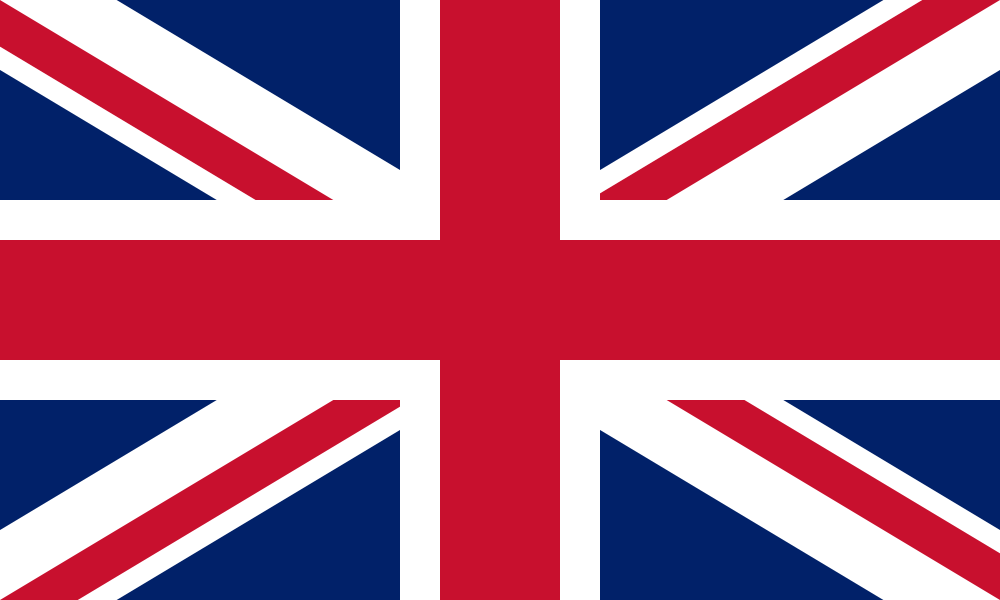
Today's Union Jack is the result of two successive mergers. In 1606, three years after the union of the English and Scottish crowns under James VI of Scotland, who became James I of England, a first flag combined the red cross of St George, patron saint of England, on a white field, with the white saltire of St Andrew, patron saint of Scotland, on a blue field.
Wales does not appear on this flag: conquered by England as early as the thirteenth century and formally incorporated into the kingdom by the Laws in Wales Acts of 1535 and 1542, it was no longer a separate kingdom by 1606.
The current design dates from 1 January 1801, when the Act of Union merged the Kingdom of Great Britain with the Kingdom of Ireland. St Patrick's red saltire, representing Ireland, was then added to the design, offset from St Andrew's saltire so that neither country would appear to take precedence over the other.
Meaning of Colors & Emblems
- Red cross of St George (white field): represents England.
- White saltire of St Andrew (blue field): represents Scotland.
- Red saltire of St Patrick: represents Ireland, today mainly Northern Ireland within the United Kingdom.
Wales remains absent from the flag, having already ceased to be a separate kingdom by the time the original Union Jack was created in 1606. This omission still fuels regular debate about a possible redesign that would include the Welsh red dragon.
Anecdotes & Fun Facts
St Patrick's saltire is not centered on St Andrew's: the red and white bands are slightly offset, a heraldic technique known as "counterchange," so that neither kingdom appears to be placed above the other.
The flag has a correct way up: the broader white diagonal band of St Patrick's saltire should sit above the red band in the upper hoist canton. Flying it upside down is traditionally a distress signal, though the mistake usually goes unnoticed today.
The origin of the name "Union Jack" is still debated: it may come from the nautical term "jack," a small flag flown at a ship's bow, or from the Latinized name of King James I, Jacobus, who presided over the first union of the crowns in 1603.
Sport and history
National teams
Athletes
- Kelly Holmes
- Mo Farah
- Bradley Wiggins
- Chris Hoy
- Christopher Froome
- Mark Cavendish
- Tom Pidcock
- Victoria Pendleton
- Graham Hill
- Jackie Stewart
- Lewis Hamilton
- Mike Hawthorn
- Eamonn Martin
- Liz McColgan
- Paula Radcliffe
- Steve Brace
- Steve Jones
- Geoff Duke
- John Surtees
- Mike Hailwood
- Derek Bell
- Woolf Barnato
- Ben Ainslie
- Charlotte Dujardin
- Giles Scott
- Jade Jones
- Jason Kenny
- Laura Trott
- Max Whitlock
- Nicola Adams
- Adam Peaty
- Rebecca Adlington
- Elizabeth Hawker
- Jonathan Albon
- Tom Evans
- Alistair Brownlee
- Chrissie Wellington
Clubs
- Aberdeen FC
- Arsenal
- Bournemouth
- Brighton and Hove Albion
- Burnley
- Cardiff City
- Celtic Glasgow
- Chelsea
- Crystal Palace
- Everton
- Fulham
- Glasgow Rangers
- Huddersfield Town
- Leicester City
- Liverpool
- Manchester City
- Manchester United
- Newcastle United
- Sheffield United
- Southampton
- Tottenham Hotspur
- Watford
- West Ham United
- Wolverhampton Wanderers
Competitions
Olympic Games
Historical figures
Frequently asked questions
What is the capital of the United Kingdom?
London is the capital of the United Kingdom.
What do the colors of the flag of the United Kingdom mean?
Red cross of St George (white field): represents England.White saltire of St Andrew (blue field): represents Scotland.Red saltire of St Patrick: represents Ireland, today mainly Northern Ireland within the United Kingdom.Wales remains absent from the flag, having already ceased to be a separate kingdom by the time the original Union Jack was created in 1606. This omission still fuels regular debate about a possible redesign that would include the Welsh red dragon.
Which countries border the United Kingdom?
The United Kingdom shares land borders with: Ireland.